Darrell Henson, 1925-2012

papa henson wedding photo

This morning my grandfather, Darrell Henson, passed away in his sleep. Next Friday would have been his eighty-seventh birthday. He was a man gifted with a quick laugh. He was a man who, in his youth, was quick to temper. He was incredibly stubborn. He was a man who constantly planned and tinkered. He was constantly at labor. So often all of that was for his family. He was the father of four children. He was the grandfather of many more.

He is gone and we are poorer for it.

After Pearl Harbor he lied about his age to serve in the Merchant Marines in the Pacific theater. He survived multiple kamikaze attacks while in the service and he kept the shrapnel from the attacks that, for a chance of fate, would have killed him. In 1988 President Reagan passed a law granting veteran status to those Merchant Marines who served in World War II, a moment that acknowledged the sacrifice and the service of my Grandfather and so many of his peers. To say that it meant a lot to him is the grossest of understatements.

He finished his work in high school only after his own children had finished high school. He was acutely aware of the importance of education and was proud of his children and grandchildren who chose education as their profession. He once showed me an essay he wrote to receive his high school diploma. It meant so much to him to receive his diploma that he kept his homework. It was written in pencil with a clean and meticulous handwriting. I have always remembered the moment he showed me that essay.

He once had a mild heart attack. He drove home to Sacramento before going to the hospital. He was in Oregon when he had the heart attack.

When I was a child, he used to pick me up from school. He would show up an hour early just to be safe. As I grew older and began to discover adolescent embarrassment, I told him he didn’t need to be so prompt. Later I begged him not to park so close to the school. He started parking across the street, but he still showed up early.

He taught me how to play poker. When two-man poker got old we would build giant forts out of old wood blocks, man them with plastic army men, and then wage war with artillery made of marbles.

We used to fish in the pond on his property. I was the biggest fish he ever caught. I fell out of the raft and tried to drown in two feet of water. He grabbed me by the scruff of my shirt and hauled me out in one motion. Not one of my best moments, but definitely one of his.

He had faced numerous health problems in the last year. He went into the hospital two weeks ago and we knew that we needed to prepare for the inevitable. I did not have the opportunity to come home to see him one last time when my other grandfather, Paul Blansett, passed away. I could not come to the funeral. I was not able to be there to support my family. It has weighed on me ever since.

I came home this weekend to do all the things I could not do when we were last faced with this crisis. He was not well off. Yet when my dad told him that I was there he lit up just a little. Then he saluted me with the slightest of smiles on his face.

Once, when complaining about the aches and pains that come with age, he paused and said that every day he woke up was a good day. That was probably twenty years ago.

Today was a bad day. I will miss him terribly. May he rest in peace.

On this weekend filled with so much tragedy, may we all find comfort in those small moments of grace that we have been fortunate enough to share with the ones we love.

Spinning My Wheels

Sadly there’s not going to be a long post this week. I’ve spent the last week basically spinning my wheels and struggling with an inability to get any real traction. Maybe it was due the inevitable post-holiday exhaustion. Maybe it came from the rather bumpy week I had at work (was it something in the air? I just couldn’t find a rhythm!) Maybe it was due to the family emergency that almost had me packing my bags to visit family this week. Probably it was some combination of all of the above.

Happily, things are looking up at the moment. Let’s keep things nice and light this week though. First, my birthday present:

New ToyIt’s shiny.

Here’s some stuff I’ve been reading on my new toy:

Spiegel Online has a story up about the incredible (and crumbling) “Atlantis” of Neft Dashlari.

Noah Shachtman writes at Wired about the search to crack the 250 year old code of a secret society.

Scientific American has an article up about the atmospheric properties that could lead to Megastorms (the sort that turn the Sacramento Valley into something more like a lake) in California’s near future. Apparently the last week of rain in CA has been the result of these sorts of atmospheric properties on the small scale.

Good reading.


Of Light

Sometimes a music video has the ability to become completely immeshed with a song. This can often be to the song’s detriment. Not so in this case. I keep coming back to Mumford & Sons’ “Lover of the Light” and its video directed by and staring Idris Elba. I highly recommend a second viewing.

Errant Reader: “Low-Lands” – Thomas Pynchon (1960)

“Low-Lands” is an early artifact of Pynchon’s work where you’re immediately aware of that signature sense of revelation waiting just beyond the horizon of the text. Sadly this sense ultimately gets lost amongst all the mixed signals permeating the text. Rather than hinting at greater revelations upon multiple readings, its pat conclusion destroys the sense of wonder that the earlier portion of the text builds.

Perhaps I shouldn’t say pat. There’s very little in Pynchon’s work that the word pat could be used as a description. Maybe I’m just reacting to the let down after reading the story. Coming back to “Low-Lands” made me long for the works that I’ll be getting to further down the line. There’s good reason for this reaction though. “Low-Lands” gives all the signals of early Pynchon at his esoteric best: long passages exploring the mysteries of ennui, the inexplicable nature of life, hijinks and humorous asides, our interconnected existence, psychology and the unhinged doctors who occasionally practice it, dream-like journeys through unlikely settings, and (though the list could go on) Pig Bodine.

While all the pieces are set for the game, the reader is likely to be left wondering if this is the game she or he thought it was. Sadly, this question doesn’t come up in the usual way it does with Pynchon either. Rather than realizing that you’re in three-dimensional chess, you realize that you’re playing checkers. Again, I’m being too harsh. Prior to V., and Gravity’s Rainbow, “Low-Lands” really does have a good deal going for it. Continue reading “Errant Reader: “Low-Lands” – Thomas Pynchon (1960)”

Errant Reader: Fear and Loathing on the Campaign Trail – Hunter S. Thompson (1973)

As promised, I finished Hunter S. Thompson’s Fear and Loathing on the Campaign Trail just in time to write a post prior to the election. I should feel pretty enthusiastic about this fact. Despite what has been a daunting schedule lately I managed to stick to my plan. Instead, I feel like I’m channeling the weary tone Thompson exudes so often in this book. This works on multiple levels. I rushed to get to the end of the book because I knew that the current election was already wearing thin on my nerves. I’m fascinated with politics in much the same unhealthy manner that Thompson describes in the book. I’m prone to burnout, but I still come back to it every election cycle. It’s a constant train wreck of human endeavor and I simply can’t look away from it for very long. And the ads…Oh the ads! (Obviously it’s a good thing I don’t live in Ohio. My emotional state would be driven to exciting new lows.) On another level I feel like I’m also rushing to write this post (for good reason because I AM rushing to write this post). It all leads to the same vibe Thompson has in the midst of the campaign trail: It’s all falling apart. A good idea for a post has gone horribly wrong and yet there’s still that looming deadline.

The joy of reading Thompson though is his prose and his candor. It stands out in these sorts of moments. I find it refreshing to read Thompson with his willing to burn his bridges of political access in order to call it like he sees it. It’s also quite entertaining.

Take, for example, Thompson’s explanation of the strange desire for people to follow politics and his own problems in meeting deadlines in the frantic pace set by a national election. Early in the book Thompson compares his tendency to keep coming back to political reporting to whatever instinct causes jackrabbits to wait until the last possible minute to dart out into traffic. The lives of jackrabbits are boring, so the thrill seeking jackrabbit sees that two lane highway and the fast moving semis and thinks “yeah, I can make it” and gets the biggest adrenaline rush possible. Yet as Thompson notes:

When a jackrabbit gets addicted to road-running, it is only a matter of time before he gets smashed—and when a journalist turns into a politics junkie he will sooner or later start raving and babbling in print about things that only a person who has Been There can possibly understand.*

It’s this candor that really draws me to Thompson’s writing. It shows that following politics this closely isn’t necessarily about being informed or informing others. It’s also not inherently about the political process or the candidates. Instead, it’s really about that rush. Thompson’s continual references to football speak to this. It’s the same rush you get when you’re watching a great game. Politics just has further reaching consequences, which makes the adrenaline rush for us jackrabbits all that stronger. It’s also refreshing to hear Thompson opine against figures like Nixon or Humphrey. There’s no shortage of this sort of tone nowadays thanks to the Internet. What’s more often missing is the sheer skill with which Thompson delivers these tirades.

The other aspect of the book that deeply enjoyed was reading about George McGovern’s campaign in 1972 as Thompson covered it in the moment. I’m something of a history lover and this era has always fascinated me. In fact, one of the first historical biographies I ever read was Anthony Summers’ Arrogance of Power: The Secret World of Richard Nixon. It was an odd book for a 19-20 year old to pick up at the local library. That said, Nixon was just this odd figure to me: a national disgrace due to Watergate, a man who seemed relentlessly angry and insecure, and simply of a political time and atmosphere that came and went well before my birth. I poured through it though and found the entire thing fascinating. I can’t say whether or not Summers’ book was very good or well researched. I simply don’t remember it in any detail. It did instill in me an interest with this era of political history and with Watergate in particular but it also meant that I’ve always been more focused on the scandals surrounding the chief Republican of the era rather than the era’s politics in general.

This is where Thompson comes in: reading his dispatches, frank and often livid as they are, really allows you to transport yourself back to pre-Watergate. You forget, briefly, that 1972 was an absolute blowout election. Admittedly, having a sense of ambiguity in the air helps. Living through another election at the same time and reading the same sorts of “in the moment” dispatches from political reporters today makes it a bit easier to transport yourself back in time.

Speaking of time, I’m officially out of it for this particular post. Hopefully I leave myself more time to write next week. Besides, the last polls before the election are out…

*Thompson, Hunter S. (2012-06-26). Fear and Loathing on the Campaign Trail ’72 (Kindle Locations 380-382). Simon & Schuster, Inc.. Kindle Edition.

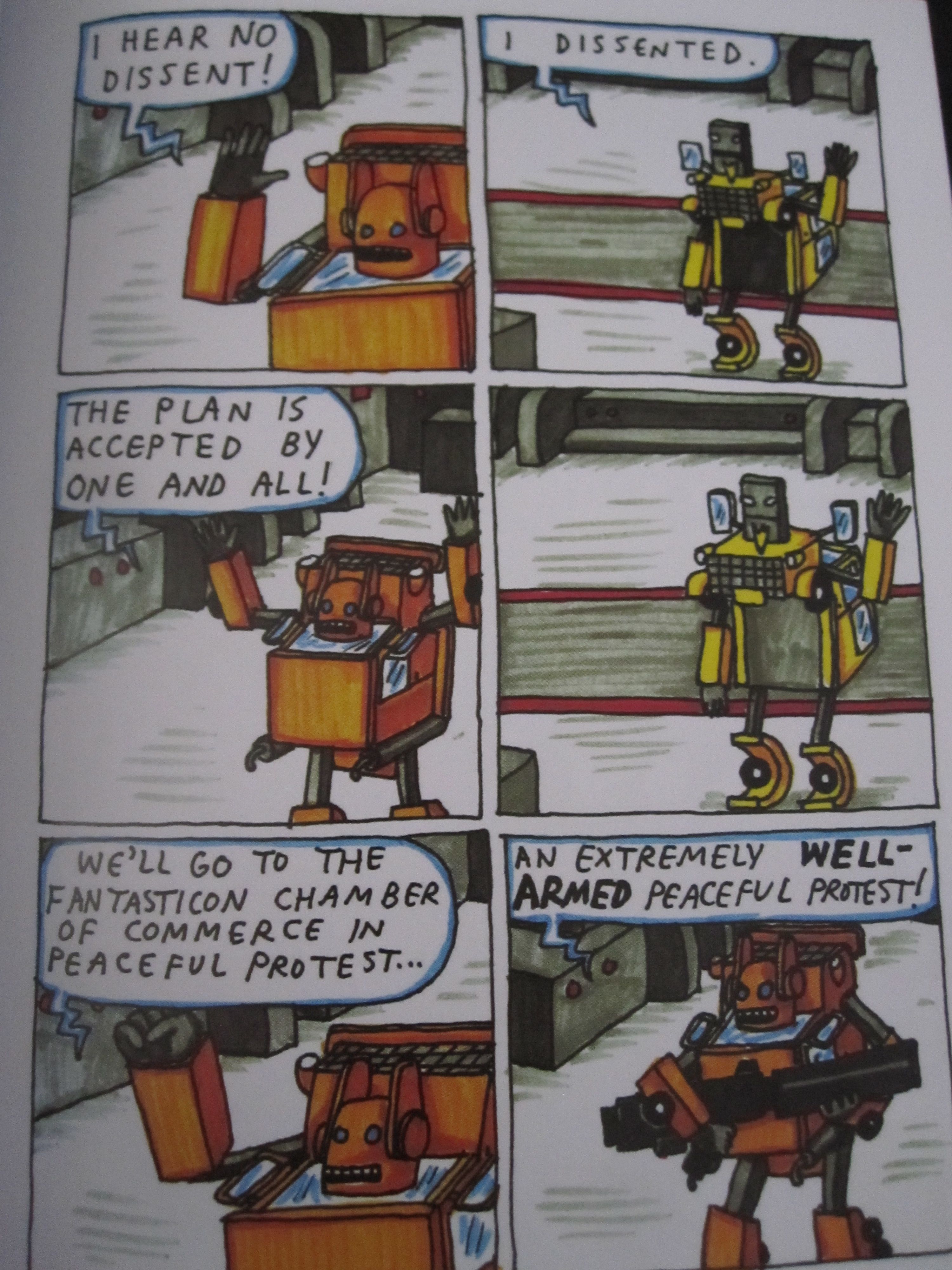
Errant Reader: Incredible Change-Bots – Jeffrey Brown (2011)

This is definitely not the next post in my series about reading Pynchon. (Well, I’m fairly certain at least. Pynchon has a deep nostalgia for 1980’s cartoons designed to sell toys, which if I’m honest, would be right up to his level of eclecticism.) I realized early last week that I was probably going to miss my self-imposed deadline for a couple reasons. First, work went a bit wonky and I had a lot of grading to do. Second, I realized that it’s almost Election Day and I need to finish Hunter S. Thompson’s Fear and Loathing on the Campaign Trail before I get too burnt out on all things political. Hence a brief post this week, Thompson next week, and then back to Pynchon (or so goes my best laid plan at the moment).

I’m also racing the clock today because I left my laptop charger at work on Friday. Which will run out first: my ability to ramble on about texts or my laptop’s battery? Only time will tell…

Continue reading “Errant Reader: Incredible Change-Bots – Jeffrey Brown (2011)”

Errant Reader: “The Small Rain” – Thomas Pynchon (1959)

This post marks the restart of an experiment I gave up on ages ago in the midst of graduate school. Back then any attempt at a regular series of posts about what I was reading was a bit of a wasted effort. It was, after all, a continuation of my “day job” and I didn’t see a lot of point in talking about books online when I could do it in real life with my fellow grad students every day. Given that I’m now a bit removed from my usual debating partners about literature, I thought it might be nice to revisit the idea. Oh, and give the series a better title (Textual Detritus…what the hell was I thinking?)

Given that I’m hitting the restart button I should point out some of the ground rules I’ve decided to use: first, I have some overarching goals, but there’s no set list of what I have to read for a given post. I want to keep this fun, spontaneous, and keeping with the “errant” title. I do want to do one post in the series every week. I guarantee that I will eventually miss this goal. So it goes.

What about those overarching goals? Well, this post is the start of goal number 1. For the last few years I’ve wanted to go back and read all of Pynchon’s work from start to finish. My dissertation work focused on his more recent novels and Gravity’s Rainbow. I read his work out of order though and I’ve been dying to go back and revisit everything in order of publication (or as near as I can manage). I’m starting out with the stories in Slow Learner (but crucially I’m not reading Pynchon’s Introduction to the book. I’ll get to that between Gravity’s Rainbow and Vineland.) I’ve always been drawn to Pynchon’s work, and I can’t think of a better way to start out this particular series. As they say: Go big or go home.

Continue reading “Errant Reader: “The Small Rain” – Thomas Pynchon (1959)”

Playing Beautiful Games

The title to this post only partly references references the links I’m about to pass along. It’s mostly about the beautiful game I’m playing in my head right now where I think (think) that I’m going to be able to start posting a bit more in the future. The new job is, if I’m honest, a bit daunting. I’ve come to the conclusion that I need to start protecting my “me” time through writing and working on some projects I’ve had percolating for the past few months. As with any big and important job it’s pretty easy to let it overwhelm your every waking moment.  It’s a route I went down a couple times during grad school and I’m not eager to revisit it. So, here’s to striking a balance!

(For those of you in the know: I really didn’t think that the title I gave that comp conference would seem so fitting to my life when I thought it up.)

Enough rambling. More links!

First, this story about Argentinian Soccer at Outside Magazine was a fascinating read if you’re interested in “The Beautiful Game.” It’s also more than a little terrifying.

One of my favorite new websites is Randall Munroe’s What If. You likely know Munroe’s work if you’ve been on the internet for more than five minutes. In fact, my even mentioning What If is probably pointless since you all know about it already. I just want to note how much fun I’m having reading these improbable scenarios.

What If also deserves my thanks for the following amazing video:

Lightning at 7,207 frames per second.

That is all.